
What Makes Quality Graphic Tees: A 2026 Buyer's Guide
Table of Contents
- What Separates Quality Graphic Tees From Plain T-Shirts
- The Best Fabric for Graphic Tees: Weight, Weave, and Cotton Type
- Screen Printing vs. Direct-to-Garment Printing: Which Lasts Longer
- Fit, Sizing, and Construction Details That Matter
- How to Wash Graphic Tees So Prints Survive the Wash Cycle
- Design, Self-Expression, and What Quality Graphic Tees Say About You
- Frequently Asked Questions
Last Updated: October 17, 2026
What Separates Quality Graphic Tees From Plain T-Shirts
A graphic tee is a T-shirt with a printed design, artwork, or typography applied to the fabric; a plain T-shirt carries no printed decoration. This guide from Eternal breaks down what makes quality graphic tees worth the money.
Most shoppers judge a graphic tee by the design alone, ignoring the shirt underneath. But a bold print on a thin, poorly cut blank will crack, fade, and lose its shape long before the design stops being interesting.
The Three Layers of a Graphic Tee
Every graphic tee is really three products stacked into one:
- The blank, the fabric, weight, and construction of the shirt itself
- The print, the method, ink, and curing that put the design on the fabric
- The design, the artwork, typography, and visual concept
A failure in any one layer drags down the other two: heavyweight cotton cannot rescue a badly cured print, and brilliant artwork will not fix a shirt that twists at the hem after three washes. Quality is the sum of all three.
The Best Fabric for Graphic Tees: Weight, Weave, and Cotton Type
The best fabric for graphic tees is 100% cotton in a ring-spun weave, at a weight matched to how you plan to wear the shirt.
Fabric choice drives comfort, breathability, and how well the print bonds. Three variables matter most:
- Fiber content, 100% cotton is the benchmark for printability and breathability. Blends can work, but cotton takes ink more predictably.
- Yarn type, ring-spun cotton feels noticeably softer against skin than carded or open-end cotton.
- Weave and finish, garment-dyed and washed finishes soften a shirt before it ever reaches you.
A common mistake is assuming heavier always means better. Heavyweight fabric drapes with structure, but a lightweight tee is better in heat or for layering. Match the material to the use, not to a number on a spec sheet.
Reading GSM and Fabric Weight
GSM (grams per square meter) measures fabric density, and it is the single most useful number on a spec sheet. As a working guide:
- Under 150 GSM, lightweight, sheer in pale colors, best for summer and layering
- 150-180 GSM, standard midweight, the everyday sweet spot
- 180-220 GSM, heavyweight, structured, holds a crisp shape
In US terms, fabric weight is often quoted in ounces per square yard. Our heavyweight pieces use 7.5 oz. garment-dyed drop-shoulder material, firmly in the structured range. GSM and ounces measure the same thing, so do not let a spec sheet confuse you by switching units.
Screen Printing vs. Direct-to-Garment Printing: Which Lasts Longer
Screen printing outlasts direct-to-garment (DTG) printing on high-volume, simple designs, while DTG wins for complex images, small runs, and fine detail. Neither is universally better; the right choice depends on the design, order size, and how the shirt will be worn and washed.
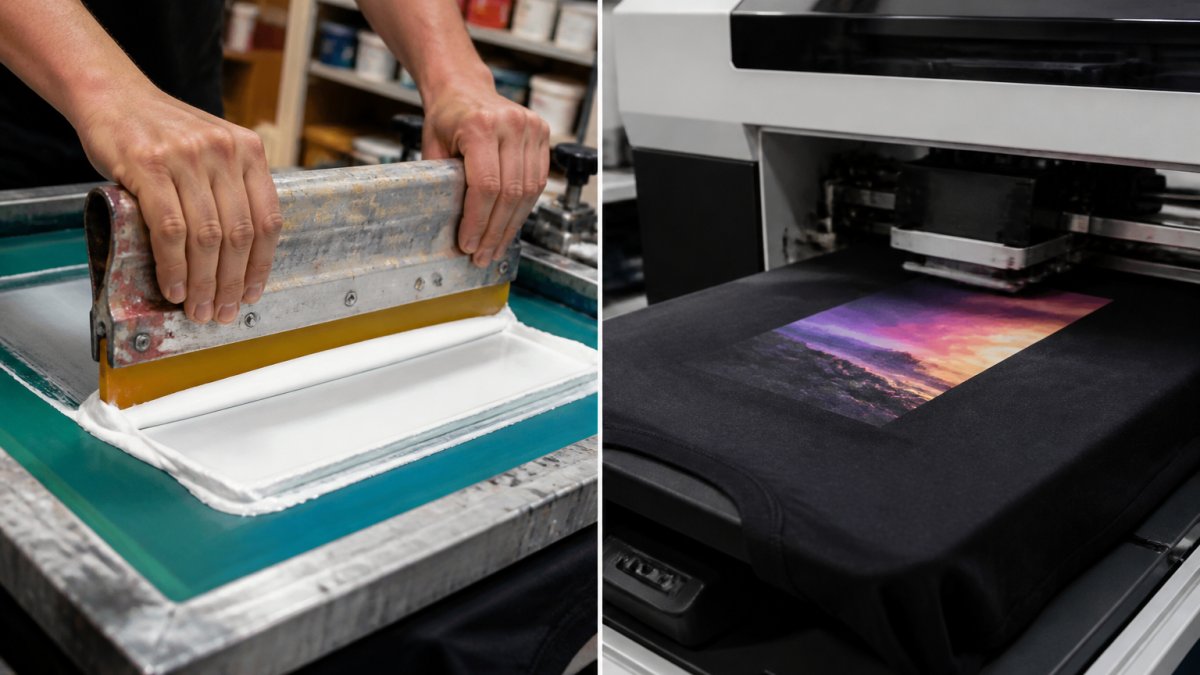
Most guides stop at "screen print for bulk, DTG for detail." That is true but incomplete. The practical question is which method fits your design and order, and how each feels, looks, and holds up.
Screen Printing
Screen printing pushes thick ink through a mesh stencil, one screen per color. The ink sits on top of the fabric and cures hard, making it exceptionally durable on bold typeface, solid shapes, and logos. It is the standard for graphics that need to survive years of wear.
- Best for: bold typeface, logos, 1-3 color designs, bulk orders
- Feel: a raised, slightly rubbery hand on the surface, especially on dark garments that need a white underbase
- Detail limit: fine gradients and photographic images are difficult and costly; each additional color adds a screen and a setup charge
Direct-to-Garment Printing
Direct-to-garment printing works like an inkjet printer for fabric, spraying water-based ink into the cotton fibers. It handles complex images, gradients, and vibrant colors that screen printing cannot reproduce economically.
- Best for: complex images, full-color artwork, small runs, one-off custom pieces
- Feel: the ink sits in the fiber rather than on top of it, so the print feels softer and more integrated than screen print
- Detail limit: excellent for photographic detail and gradients; less opaque on dark garments unless a pretreatment and white underbase are used
Heat Transfer and Vinyl
Heat transfer and vinyl apply a pre-cut or printed film to fabric with heat and pressure, common for names, numbers, and small custom orders.
- Best for: names, numbers, small custom orders, single-color personalization
- Feel: a distinct film layer that can feel plasticky on large areas
- Detail limit: good for simple shapes and text; not suited to photographic detail
Choosing by Use Case
| Print Method | Best For | Feel | Detail Limit | Order Size Fit | Durability Outlook |
|---|---|---|---|---|---|
| Screen printing | Bold typeface, logos, 1-3 color designs | Raised, slightly rubbery | Low; costly per color | Bulk | Excellent on cured, quality ink |
| Direct-to-garment | Complex images, full-color artwork | Soft, integrated | High | Small runs to mid-volume | Good when produced correctly |
| Heat transfer / vinyl | Names, numbers, small custom orders | Film-like on large areas | Low to moderate | Very small runs, one-offs | Moderate; edges can peel |
The method matters less than the execution: a well-cured DTG print on quality cotton will outlast a cheaply produced screen print every time. Ask how a print is cured, not just how it is applied.
**Fabric weight**, does the shirt feel substantial without being stiff? Check the GSM or ounce figure if listed.- Stretch recovery, pull the hem gently. Quality cotton springs back; cheap fabric stays stretched.
- Side seams, a real side seam means a properly cut garment. A tube body with no side seams twists over time.
Fit, Sizing, and Construction Details That Matter
Fit is where most online apparel purchases go wrong, and sizing consistency separates a brand you trust from one you return.
Construction details beyond fabric weight are the quiet signals of quality:
- Shoulder taping, reinforces the neckline and stops it from sagging
- Double-needle hems, resist unraveling at the sleeves and bottom
- Drop-shoulder cuts, a deliberate oversized silhouette, not a sizing error
Sizing honesty matters as much as construction. Some of our oversized and drop-shoulder pieces run about one size larger than standard, and we say so plainly on the product page. If a brand will not tell you how its shirts run, that silence is a red flag.
How to Wash Graphic Tees So Prints Survive the Wash Cycle
Wash graphic tees inside out in cold water on a gentle cycle, and tumble dry low or hang dry. Heat is the enemy of both print and cotton, and most print cracking traces back to a hot dryer rather than a bad print job.
A wash routine that protects the graphic:
- Turn the shirt inside out before washing to reduce abrasion against the print.
- Use cold water and a mild detergent; skip bleach and fabric softener, which degrade ink and cotton alike.
- Wash on a gentle cycle with similar colors, and avoid overloading the machine.
- Tumble dry low or hang dry. If you can air dry, do it; the print will thank you.
- Iron inside out on low heat, never directly on the graphic.
Care is where print durability is actually decided. A shirt that survives fifty cold washes inside out will outlast one that meets a hot dryer weekly, regardless of how it was printed.
A Repeatable Wash Test for Print Durability
Most care guides tell you what to do but never how to check whether a tee is holding up. Run this simple wash test at home to judge print durability and fabric performance over time.
- Baseline the shirt. Before the first wash, photograph the print and note any existing cracking, fading, or shrinkage. Measure the chest width and body length flat and record the numbers.
- Wash and dry on your normal routine for five cycles, following the care instructions above. Keep the routine consistent so the test reflects real use.
- Re-check after each cycle. Look for three failure signs: cracking (ink splitting along fold lines), fading (color loss, especially on dark garments), and peeling (edges lifting, most common on heat transfer and vinyl).
- Measure shrinkage. Re-measure chest width and body length after the first wash and after the fifth. Cotton commonly shrinks in the first wash; a quality garment should stabilize rather than keep shrinking.
- Check collar recovery. Stretch the collar gently and release. A ribbed, taped collar should spring back; a thin collar that stays stretched is a construction warning.
A tee with no new cracking, minimal fading, stable measurements, and a collar that recovers after five cycles is a strong sign of quality. One that cracks, fades, or keeps shrinking is telling you something the spec sheet did not.
What the Failure Signs Mean
- Cracking usually points to under-cured ink or a print applied too thickly; it is more common on screen prints and heat transfers.
- Fading often traces to dye quality and hot washing; dark garments and saturated colors show it first.
- Peeling is most common on heat transfer and vinyl, especially at edges exposed to heat and abrasion.
American Cleaning Institute laundry care guidance
Design, Self-Expression, and What Quality Graphic Tees Say About You
A graphic tee is a statement before anyone reads a word on it. The design, typography, color, and cut communicate your interests and personal style, and quality graphic tees make that statement hold up over time.
Design and construction cannot be separated: a shirt that fades or cracks after a month stops saying what you meant it to say, while a well-built one keeps the message intact, wash after wash. That is the idea behind everything we make at Eternal: apparel that carries a message of faith and hope through a distressed, graffiti-inspired aesthetic, built on heavyweight garment-dyed blanks and full-color prints. Our Gotta Be Da Shoes T-Shirt pairs a large full-color DTG print with a super-soft cotton tee, and our Eternal Chainlink Back Custom T-Shirt is hand-finished in small batches on 7.5 oz. heavyweight material, so the shirt underneath the design is as considered as the artwork on it.


Style is personal. The quality underneath it should not be a gamble.
Frequently Asked Questions
What makes a graphic tee high quality?
Three things decide it: the fabric, the print, and the construction. Look for 100% cotton or ring-spun cotton with a stated fabric weight, a print that sits in the fabric rather than on top of it, and clean double-stitched seams at the collar and hem. A quality graphic tee also keeps its shape after washing, which is where cheap shirts fail first. Ask the brand for fabric weight and print method before you buy; if they cannot tell you, that tells you something too.
What is the best fabric for graphic tees?
Ring-spun cotton is the best fabric for graphic tees in most cases. The extra spinning step makes the yarn smoother and softer, and it takes both screen printing and direct-to-garment printing well. Lightweight fabric around 4.5 to 5.5 oz works for summer wear, while 6 to 7.5 oz heavyweight fabric holds structure and drapes better on oversized cuts. Blends with polyester can be durable but tend to pill faster and hold print differently, so check the label before ordering.
What is the difference between screen printing and direct-to-garment printing?
Screen printing pushes thick ink through a mesh stencil, one layer per color. It is durable, cost-effective at volume, and gives bold, saturated results, but it works best on simple designs with limited colors. Direct-to-garment printing sprays water-based ink directly into the fabric, like a printer for shirts. It handles complex images, gradients, and full-color artwork without setup costs, but the print can feel softer and needs careful washing. Choose screen printing for bold logos and DTG for detailed artwork.
How do you keep a graphic tee from fading or cracking?
Wash graphic tees inside out in cold water on a gentle cycle, and skip the dryer or use low heat. Heat is what cracks prints and fades color. Use a mild detergent without bleach, avoid fabric softener on the printed area, and never iron directly over the design. Hang or lay flat to dry when you can. Following these steps on how to wash graphic tees can add years to a print, especially on direct-to-garment styles where the ink sits closer to the surface.
Does a heavier T-shirt mean better quality?
Not automatically. Heavier fabric, such as a 7.5 oz heavyweight garment, feels more substantial and holds an oversized drape well, which many people prefer for streetwear. But weight alone does not guarantee quality. A heavy shirt with poor stitching or a cheap print can still fall apart. Judge fabric weight alongside cotton type, seam construction, and print method. A 5 oz ring-spun tee with clean construction often outlasts a heavy shirt built carelessly.
How should a graphic tee fit?
A graphic tee should sit cleanly across the shoulders with the shoulder seam at the edge of your shoulder, not hanging past it. The body should skim your torso without pulling at the chest or bunching at the waist. Sleeves should end mid-bicep. Oversized cuts are a deliberate style choice, not a sizing error, so check the product listing for notes like runs one size larger before ordering. When in doubt, measure a shirt you already like and compare it to the brand's size chart.
Buying graphic tees online means trusting a brand you cannot touch first. We built Eternal to earn that trust: heavyweight garment-dyed blanks, full-color prints on soft cotton, and sizing notes published up front so you know what you are getting. Explore the LVN God's Plan T-Shirt or view the full collection to find a piece that carries your message and holds up to the wash cycle.
